|
mutLBSgeneDB |
| |
| |
| |
| |
| |
| |
|

| Gene summary for GCKR |
 Gene summary Gene summary |
| Basic gene Info. | Gene symbol | GCKR |
| Gene name | glucokinase (hexokinase 4) regulator | |
| Synonyms | FGQTL5|GKRP | |
| Cytomap | UCSC genome browser: 2p23 | |
| Type of gene | protein-coding | |
| RefGenes | NM_001486.3, | |
| Description | glucokinase regulatory protein | |
| Modification date | 20141211 | |
| dbXrefs | MIM : 600842 | |
| HGNC : HGNC | ||
| Ensembl : ENSG00000084734 | ||
| HPRD : 02909 | ||
| Vega : OTTHUMG00000128426 | ||
| Protein | UniProt: Q14397 go to UniProt's Cross Reference DB Table | |
| Expression | CleanEX: HS_GCKR | |
| BioGPS: 2646 | ||
| Pathway | NCI Pathway Interaction Database: GCKR | |
| KEGG: GCKR | ||
| REACTOME: GCKR | ||
| Pathway Commons: GCKR | ||
| Context | iHOP: GCKR | |
| ligand binding site mutation search in PubMed: GCKR | ||
| UCL Cancer Institute: GCKR | ||
| Assigned class in mutLBSgeneDB | C: This gene just belongs to mutLBSgenes. | |
| Gene ontology having evidence of Inferred from Direct Assay (IDA) from Entrez |
| GO ID | GO Term | PubMed ID | GO:0009750 | response to fructose | 14627435 | GO:0033132 | negative regulation of glucokinase activity | 14627435 |
| Top |
| Ligand binding site mutations for GCKR |
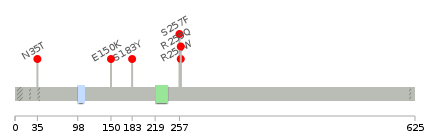
| Lollipop-style diagram of mutations at LBS in amino-acid sequence. We represented ligand binding site mutations only. (You can see big image via clicking.)  : non-synonymous mutation on LBS, Circle size denotes number of samples. : non-synonymous mutation on LBS, Circle size denotes number of samples. |
 |
| Cancer type specific mutLBS sorted by frequency |
| LBS | AAchange of nsSNV | Cancer type | # samples | R259 | R259Q | COAD | 1 | S34 | N35T | LUSC | 1 | R259 | R259W | LUSC | 1 | S257 | S257F | SKCM | 1 | E150 | E150K | UCEC | 1 | S183 | S183Y | UCEC | 1 |
| cf) Cancer type abbreviation. BLCA: Bladder urothelial carcinoma, BRCA: Breast invasive carcinoma, CESC: Cervical squamous cell carcinoma and endocervical adenocarcinoma, COAD: Colon adenocarcinoma, GBM: Glioblastoma multiforme, LGG: Brain lower grade glioma, HNSC: Head and neck squamous cell carcinoma, KICH: Kidney chromophobe, KIRC: Kidney renal clear cell carcinoma, KIRP: Kidney renal papillary cell carcinoma, LAML: Acute myeloid leukemia, LUAD: Lung adenocarcinoma, LUSC: Lung squamous cell carcinoma, OV: Ovarian serous cystadenocarcinoma, PAAD: Pancreatic adenocarcinoma, PRAD: Prostate adenocarcinoma, SKCM: Skin cutaneous melanoma, STAD: Stomach adenocarcinoma, THCA: Thyroid carcinoma, UCEC: Uterine corpus endometrial carcinoma. |
| Top |
| Protein structure related information for GCKR |
| Relative protein structure stability change (ΔΔE) using Mupro 1.1 Mupro score denotes assessment of the effect of mutations on thermodynamic stability. (ΔΔE<0: mutation decreases stability, ΔΔE>0: mutation increases stability) |
 : nsSNV at non-LBS : nsSNV at non-LBS : nsSNV at LBS : nsSNV at LBS |
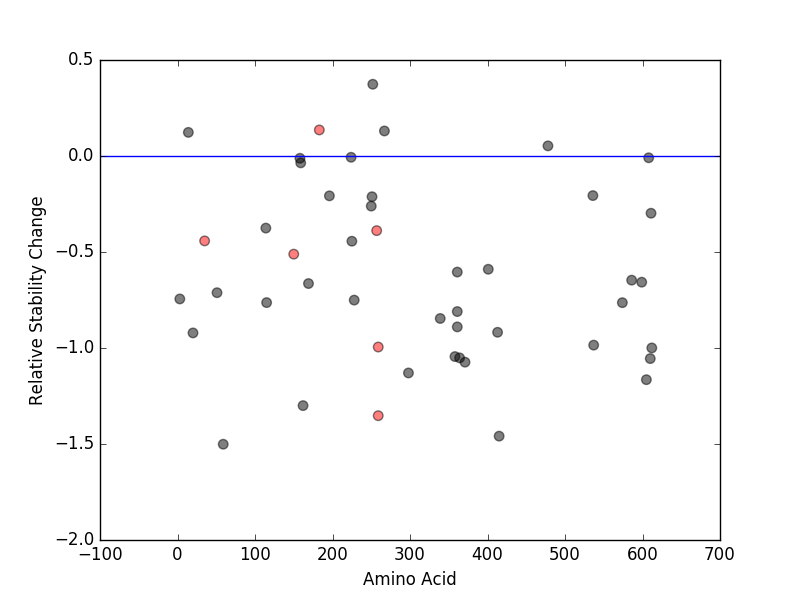 |
| nsSNVs sorted by the relative stability change of protein structure by each mutation Blue: mutations of positive stability change. and red : the most recurrent mutation for this gene. |
| LBS | AAchange of nsSNV | Relative stability change | S183 | S183Y | 0.1357207 | R259 | R259Q | -1.3525338 | R259 | R259W | -0.99492406 | E150 | E150K | -0.51114947 | S34 | N35T | -0.44217411 | S257 | S257F | -0.38865614 |
| (MuPro1.1: Jianlin Cheng et al., Prediction of Protein Stability Changes for Single-Site Mutations Using Support Vector Machines, PROTEINS: Structure, Function, and Bioinformatics. 2006, 62:1125-1132) |
| Structure image for GCKR from PDB |
| Top |
| Differential gene expression and gene-gene network for GCKR |
| Differential gene expression between mutated and non-mutated LBS samples in all 16 major cancer types |
| Differential co-expressed gene network based on protein-protein interaction data (CePIN) |
| Top |
| Top |
| Phenotype information for GCKR |
| Gene level disease information (DisGeNet) |
| Disease ID | Disease name | # PubMed | Association type |
| umls:C0011860 | Diabetes Mellitus, Type 2 | 30 | Biomarker, GeneticVariation |
| umls:C0020557 | Hypertriglyceridemia | 4 | Biomarker, GeneticVariation |
| Mutation level pathogenic information (ClinVar annotation) |
| Allele ID | AA change | Clinical significance | Origin | Phenotype IDs |
| Top |
| Pharmacological information for GCKR |
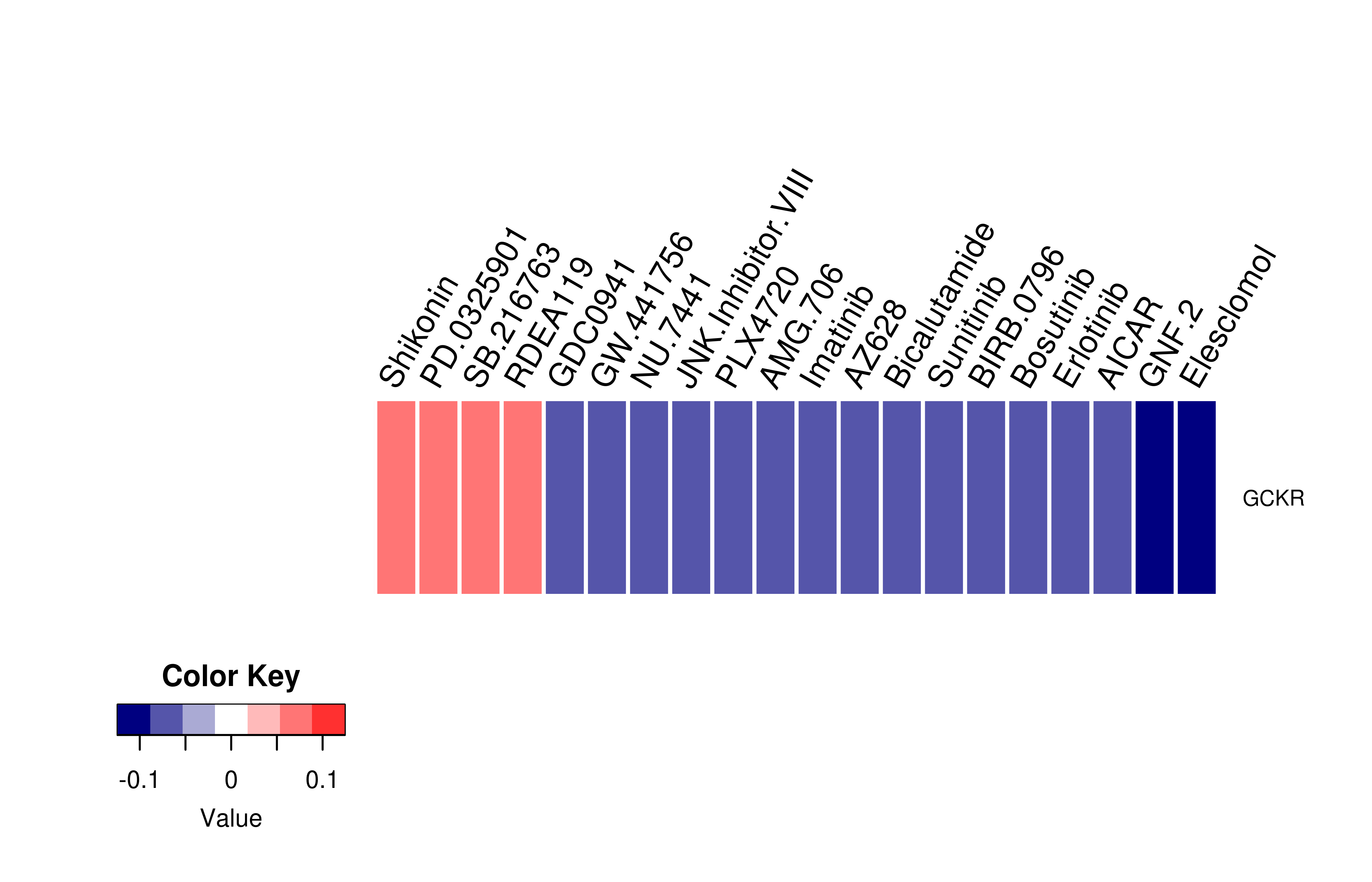
| Gene expression profile of anticancer drug treated cell-lines (CCLE) Heatmap showing the correlation between gene expression and drug response across all the cell-lines. We chose the top 20 among 138 drugs.We used Pearson's correlation coefficient. |
 |
| Drug information targeting mutLBSgene (Approved drugs only) |
| Drug status | DrugBank ID | Name | Type | Drug structure |
| Gene-centered ligand-gene interaction network |
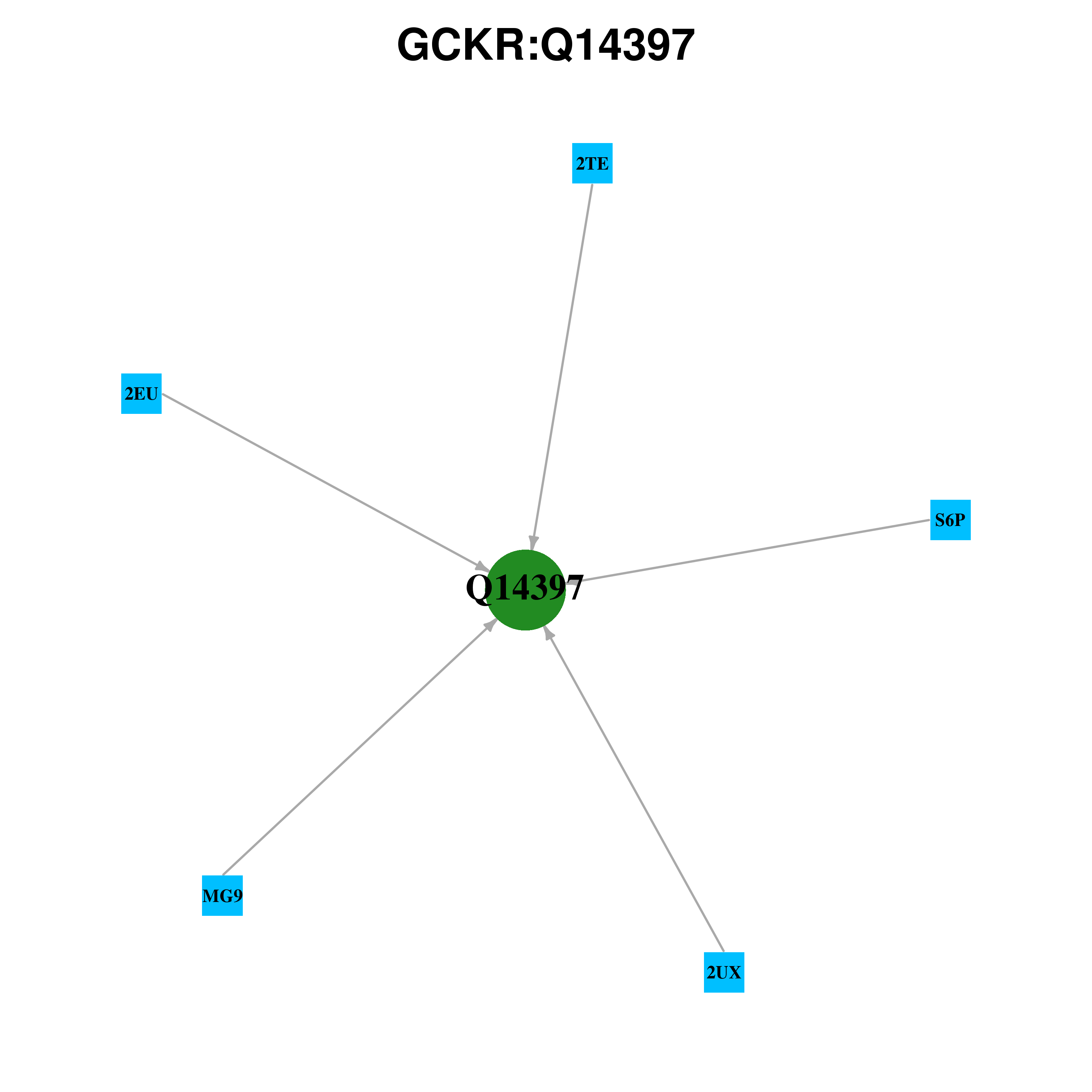 |
| Ligands binding to mutated ligand binding site of GCKR go to BioLip |
| Ligand ID | Ligand short name | Ligand long name | PDB ID | PDB name | mutLBS | S6P | SORBITOL 6-PHOSPHATE | 4op3 | A | E150 R259 | S6P | SORBITOL 6-PHOSPHATE | 4ohk | A | E150 R259 | S6P | SORBITOL 6-PHOSPHATE | 4ly9 | A | E150 S257 R259 | S6P | SORBITOL 6-PHOSPHATE | 4ly9 | B | E150 S257 R259 | S6P | SORBITOL 6-PHOSPHATE | 4msu | A | E150 S257 R259 | S6P | SORBITOL 6-PHOSPHATE | 4msu | B | E150 S257 R259 | S6P | SORBITOL 6-PHOSPHATE | 4mqu | A | E150 S257 R259 | S6P | SORBITOL 6-PHOSPHATE | 4mqu | B | E150 S257 R259 | S6P | SORBITOL 6-PHOSPHATE | 4mro | A | E150 S257 R259 | S6P | SORBITOL 6-PHOSPHATE | 4mro | B | E150 S257 R259 | S6P | SORBITOL 6-PHOSPHATE | 4olh | A | E150 S257 R259 | S6P | SORBITOL 6-PHOSPHATE | 4olh | B | E150 S257 R259 | S6P | SORBITOL 6-PHOSPHATE | 4ohm | A | E150 S257 R259 | S6P | SORBITOL 6-PHOSPHATE | 4ohm | B | E150 S257 R259 | S6P | SORBITOL 6-PHOSPHATE | 4oho | A | E150 S257 R259 | S6P | SORBITOL 6-PHOSPHATE | 4oho | B | E150 S257 R259 | S6P | SORBITOL 6-PHOSPHATE | 4ohp | A | E150 S257 R259 | S6P | SORBITOL 6-PHOSPHATE | 4ohp | B | E150 S257 R259 | S6P | SORBITOL 6-PHOSPHATE | 4op1 | A | E150 S257 R259 | S6P | SORBITOL 6-PHOSPHATE | 4op1 | B | E150 S257 R259 | S6P | SORBITOL 6-PHOSPHATE | 4op2 | A | E150 S257 R259 | S6P | SORBITOL 6-PHOSPHATE | 4op2 | B | E150 S257 R259 | S6P | SORBITOL 6-PHOSPHATE | 4op3 | B | E150 S257 R259 | S6P | SORBITOL 6-PHOSPHATE | 4ohk | B | E150 S257 R259 | S6P | SORBITOL 6-PHOSPHATE | 4pxs | A | E150 S257 R259 | S6P | SORBITOL 6-PHOSPHATE | 4pxs | B | E150 S257 R259 | S6P | SORBITOL 6-PHOSPHATE | 4px2 | A | E150 S257 R259 | S6P | SORBITOL 6-PHOSPHATE | 4px2 | B | E150 S257 R259 | S6P | SORBITOL 6-PHOSPHATE | 4px3 | A | E150 S257 R259 | S6P | SORBITOL 6-PHOSPHATE | 4px3 | B | E150 S257 R259 | S6P | SORBITOL 6-PHOSPHATE | 4px5 | A | E150 S257 R259 | S6P | SORBITOL 6-PHOSPHATE | 4px5 | B | E150 S257 R259 | 2EU | 1,1,1,3,3,3-HEXAFLUORO-2-{4-[4-(THIOPHEN-2-YLSULFONYL) PIPERAZIN-1-YL]PHENYL}PROPAN-2-OL | 4msu | A | S183 | MG9 | AMG-3969 | 2-{4-[(2S)-4-[(6-AMINOPYRIDIN-3-YL)SULFONYL]-2-(PROP-1- YN-1-YL)PIPERAZIN-1-YL]PHENYL}-1,1,1,3,3,3- HEXAFLUOROPROPAN-2-OL | 4mqu | A | S183 | 2UX | (2S)-2-{4'-[(6-AMINOPYRIDIN-3-YL)SULFONYL]BIPHENYL-4- YL}-1,1,1-TRIFLUOROPROPAN-2-OL | 4op2 | A | S183 | 2TE | (2R)-2-{4-[(2S)-4-[(6-AMINOPYRIDIN-3-YL)SULFONYL]-2- (PROP-1-YN-1-YL)PIPERAZIN-1-YL]PHENYL}-1,1,1- TRIFLUOROHEX-4-YN-2-OL | 4ohk | A | S183 | 2TJ | 4-[(2S)-4-[(6-AMINOPYRIDIN-3-YL)SULFONYL]-2-(PROP-1-YN- 1-YL)PIPERAZIN-1-YL]-N-METHYLBENZENESULFONAMIDE | 4ohp | A | S34 |
| Top |
| Conservation information for LBS of GCKR |
| Multiple alignments for Q14397 in multiple species |
| LBS | AA sequence | # species | Species | A184 | SVGLSAPFVAG | 3 | Homo sapiens, Mus musculus, Rattus norvegicus | A214 | NPVSMARNDPI | 3 | Homo sapiens, Mus musculus, Rattus norvegicus | A27 | SGYEAAVPITE | 3 | Homo sapiens, Mus musculus, Rattus norvegicus | A521 | FWRALAMLQRF | 2 | Homo sapiens, Rattus norvegicus | A521 | ---------RF | 1 | Mus musculus | D217 | SMARNDPIEDW | 3 | Homo sapiens, Mus musculus, Rattus norvegicus | E150 | VVASREGTEDS | 1 | Homo sapiens | E150 | VVASRERTEDS | 1 | Mus musculus | E150 | VVASREQTEDS | 1 | Rattus norvegicus | E153 | SREGTEDSALH | 1 | Homo sapiens | E153 | SRERTEDSALH | 1 | Mus musculus | E153 | SREQTEDSALH | 1 | Rattus norvegicus | E32 | AVPITEKSNPL | 3 | Homo sapiens, Mus musculus, Rattus norvegicus | E348 | IMDGVECIHTF | 3 | Homo sapiens, Mus musculus, Rattus norvegicus | E566 | VQVAHEKEKVI | 2 | Mus musculus, Rattus norvegicus | E566 | VQVAHEKEQVI | 1 | Homo sapiens | E568 | VAHEKEKVIPT | 2 | Mus musculus, Rattus norvegicus | E568 | VAHEKEQVIPI | 1 | Homo sapiens | F526 | AMLQRFSGQSK | 2 | Homo sapiens, Rattus norvegicus | F526 | ----RFSGQSK | 1 | Mus musculus | G107 | VVLSGGGTSGR | 3 | Homo sapiens, Mus musculus, Rattus norvegicus | G108 | VLSGGGTSGRM | 3 | Homo sapiens, Mus musculus, Rattus norvegicus | G181 | IGISVGLSAPF | 3 | Homo sapiens, Mus musculus, Rattus norvegicus | H351 | GVECIHTFGAD | 3 | Homo sapiens, Mus musculus, Rattus norvegicus | H504 | KILQNHMLDLR | 2 | Homo sapiens, Rattus norvegicus | H504 | ----------- | 1 | Mus musculus | H9 | TKRYQHVIETP | 2 | Mus musculus, Rattus norvegicus | H9 | TKRFQHVIETP | 1 | Homo sapiens | I11 | RYQHVIETPEP | 2 | Mus musculus, Rattus norvegicus | I11 | RFQHVIETPEP | 1 | Homo sapiens | K514 | RISNSKLFWRA | 1 | Homo sapiens | K514 | ----------- | 1 | Mus musculus | K514 | RIANSKLFWRA | 1 | Rattus norvegicus | M213 | FNPVSMARNDP | 3 | Homo sapiens, Mus musculus, Rattus norvegicus | M522 | WRALAMLQRFS | 2 | Homo sapiens, Rattus norvegicus | M522 | --------RFS | 1 | Mus musculus | N209 | VLVGFNPVSMA | 3 | Homo sapiens, Mus musculus, Rattus norvegicus | N216 | VSMARNDPIED | 3 | Homo sapiens, Mus musculus, Rattus norvegicus | N512 | DLRISNSKLFW | 1 | Homo sapiens | N512 | ----------- | 1 | Mus musculus | N512 | DLRIANSKLFW | 1 | Rattus norvegicus | P29 | YEAAVPITEKS | 3 | Homo sapiens, Mus musculus, Rattus norvegicus | Q524 | ALAMLQRFSGQ | 2 | Homo sapiens, Rattus norvegicus | Q524 | ------RFSGQ | 1 | Mus musculus | R215 | PVSMARNDPIE | 3 | Homo sapiens, Mus musculus, Rattus norvegicus | R259 | LSGSSRMKGGS | 2 | Homo sapiens, Mus musculus | R259 | LSGSSRMKGGG | 1 | Rattus norvegicus | R518 | SKLFWRALAML | 2 | Homo sapiens, Rattus norvegicus | R518 | ----------- | 1 | Mus musculus | R525 | LAMLQRFSGQS | 2 | Homo sapiens, Rattus norvegicus | R525 | -----RFSGQS | 1 | Mus musculus | S110 | SGGGTSGRMAF | 3 | Homo sapiens, Mus musculus, Rattus norvegicus | S179 | VVIGISVGLSA | 2 | Mus musculus, Rattus norvegicus | S179 | IVIGISVGLSA | 1 | Homo sapiens | S183 | ISVGLSAPFVA | 3 | Homo sapiens, Mus musculus, Rattus norvegicus | S257 | EGLSGSSRMKG | 3 | Homo sapiens, Mus musculus, Rattus norvegicus | S258 | GLSGSSRMKGG | 3 | Homo sapiens, Mus musculus, Rattus norvegicus | S34 | PITEKSNPLTR | 2 | Mus musculus, Rattus norvegicus | S34 | PITEKSNPLTQ | 1 | Homo sapiens | T109 | LSGGGTSGRMA | 3 | Homo sapiens, Mus musculus, Rattus norvegicus | V10 | KRYQHVIETPE | 2 | Mus musculus, Rattus norvegicus | V10 | KRFQHVIETPE | 1 | Homo sapiens | V180 | VIGISVGLSAP | 3 | Homo sapiens, Mus musculus, Rattus norvegicus | V28 | GYEAAVPITEK | 3 | Homo sapiens, Mus musculus, Rattus norvegicus | W517 | NSKLFWRALAM | 2 | Homo sapiens, Rattus norvegicus | W517 | ----------- | 1 | Mus musculus | Y24 | WELSGYEAAVP | 3 | Homo sapiens, Mus musculus, Rattus norvegicus |
 |
Copyright © 2016-Present - The University of Texas Health Science Center at Houston |